
Please help me welcome today’s guest, Patricia McAlexander…
“Researching My Ancestors for Second Wives”
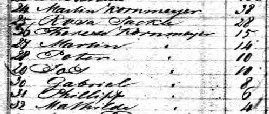
On a January afternoon in 2018, I sat at a computer in the Heritage Room of the Athens-Clarke County Library in Athens, Georgia, excited as an image came up on Ancestry.com—the manifest listing the name, gender, age, and birthplace of each passenger arriving in New York Harbor from Rotterdam on the barque Jane E. Williams, on October 7, 1850. There I found the name of my great-great-grandfather: “Martin Kornmeyer (M) 38, Farmer, Baden.” Listed below were the names of those traveling with him:
Rosa Jackle (F) 28, Baden
Theresa Kornmeyer (F) 15, Baden
Martin Kornmeyer (M) 14, Baden
Peter Kornmeyer (M) 12, Baden
Joseph Kornmeyer (M ) 10, Baden
Gabriel Kornmeyer (M) 8, Baden
Phillip Kornmeyer (M) 6, Baden
Mathilda Kornmeyer (F) 4, Baden
The last seven names were, of course, his children. But the list raised several questions. Catholic Church records had listed the Kornmeyer family—which presumably would have been Martin, his wife Maria Ursula Uhl, and their seven children—as leaving the town of Böhringen, Baden, in 1848, on their way to the New World. But where was Martin’s wife? And who was Rosa Jackle? She was not another child—she was only ten years younger than Martin. Finally, passage across the Atlantic at that time took six to twelve weeks, so the Jane E. Williams must have left Rotterdam sometime in the late summer of 1850. What had happened to the family during the two years after they left Böhringen? And what were the stories of those children in America, especially the younger Martin Kornmeyer, my great-grandfather, and his daughter Emma, my grandmother, born there in 1877?
Left to me were only documents on Ancestry.com; a nineteenth-century painting of the Jane E. Williams that came upon Google; gravestones in a Boonville, New York, cemetery; passed-down family tales and mementos—old photographs, letters, yellowed newspaper articles; my grandmother’s two-stone topaz engagement ring. Realizing how little I knew about the lives of these ancestors, even with help from other descendants, I decided their full story could be told only as historical fiction. I would have to fill in the blanks with imagination.
So, with notes and photocopied documents at hand, I began to write Second Wives. I used mostly their real names, adhered to the timeline of actual events, and embedded into the novel family tales and mementoes. Even as the novel was in progress, I researched the historical background, traveled up the Rhine as the Kornmeyers must have on their journey from Baden to Rotterdam, and visited sites of family homes and graves in Boonville, New York, where they settled.
I’ve always felt that one of the rewards of writing is the process itself, but that was especially true with Second Wives, as those ancestors I never knew came to life for me. But even more rewarding is when I’m told they came to life for readers as well.
About:
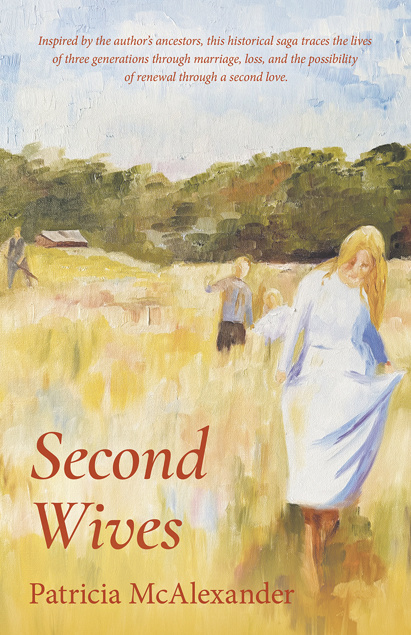
Inspired by the author’s ancestors, this historical saga traces the lives of three generations through marriage, loss, and the possibility of renewal through a second love.
Excerpt:
Martin reached down, scooped up a handful of soil, and, opening his fist, showed it to her. “I’ve loved this land, worked this soil, all my life. It will always be a part of me. But the crops have failed too many times. The farm is mortgaged. We would lose it if we stayed longer. And you know the political situation here.” He let the soil sift through his fingers back to the ground. “I will find new land in America. It will be a better home there for Esther and our children and their children.”
Rosa recognized in his eyes, his voice, the kind of passion she’d seen in Johannes when he talked of politics, of revolution. She turned away to look out past the farmhouse and barn to the winter-barren land beyond. She thought of the ragged men in the cities, of their angry demonstrations, of what Johannes had said about America. She turned back. “Yes, I see why you have to go.” Pulling her hood back over her head, she began moving out into the wind. “And it’s time for me to go back to Stuttgart. I’ll find work there as a governess.”
“Rosa!” He reached out and took her arm. “Esther and I want you to come with us.”
Buy link https://www.amazon.com/dp/B0GTWT772K
Note: If you search for Second Wives on Amazon, for some reason the search bar has my name as Patricia ALEXANDER—they’ve omitted the Mc. They tell me it has to do with autocorrect and cannot be changed. Pay no attention. The book comes up anyway.
About the Author:
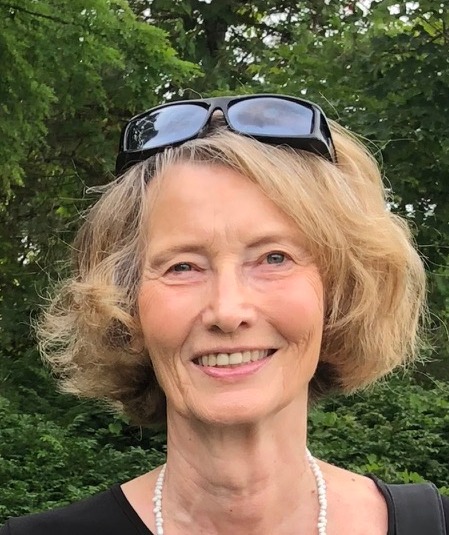
Originally from upstate New York, Patricia Jewell McAlexander earned degrees from the State University of New York at Albany, Columbia University, and The University of Wisconsin, Madison, all in English. It was in Madison that she met her Southerner husband, Hubert, a fellow graduate student. They made Athens, Georgia their home, raised their son there, and taught at the University of Georgia. After retiring, Patricia has had more time to garden and travel while renewing her interests in photography, history, and, most of all, writing fiction.. Since 2020 she has published four contemporary novels of romantic suspense—Stranger in the Storm, Shadows of Doubt, The Student in Classroom Six, and The Last Golden Isle. In her most recent novel, Second Wives, she combines the romance and psychological complexity of her previous works with family lore and genealogical research to create her first novel of historical fiction.
Email: mcalexanderpatricia@gmail.com
Website: https://patriciamcalexander.weebly.com
Instagram: www.instagram.com/patriciamcalexander/
Facebook: https://www.facebook.com/AthensGeorgiawriter
X (Twitter): https://twitter.com/PatMcAlexWriter


