Tag Archives: Kindle Unlimited

Tuesday Two-Minute Writing Tip – The Lost Art of the Beautifully Turned Phrase

Got two minutes? Then check out this week’s quick tip ~ Evoking imagery with lovely literary lines

Hello and welcome…I am a freelance editor and an editor for The Wild Rose Press, as well as an author. I often struggle with my own writing, and I have found that sometimes, a little reminder of ways to improve the process can be helpful, so, I like to share these moments of brilliance with others :). But, in this busy world of ours, who has time for pages and pages of writing tips? That’s why I’ve condensed mine down to quick flashes you can read in (approximately) two minutes. Enjoy…
TWoMinuteTip

Disclaimer: All of my tips are suggestions, and are only my opinion. And, for the most part, there are exceptions when going against my advice will make your story read better. Take what works, leave the rest. 

Although beautiful, unique, metaphoric phrases and similes are normally associated with literary works, there is no reason that non-literary authors cannot use them as well. It’s not something I do well, or that I have even attempted in my writing, but when I run across it in other books, I get the warm fuzzies, and just a tough of envy. A book I’m currently reading, THE KIND WORTH KILLING, has some great lines. I’ve shared a few below.  

  • It had been raining in Boston, but in Maine, the rain had become biblical, my wipers on full speed barely able to clear the windshield. 
  • I had watched Lily, in the course of her short speech, become briefly passionate, her face pushing toward me like a sun worshiper tilting toward the sun to get most of its rays. 
  • Deep shadows accentuated her curves, and her face, cast in the TV’s light, seemed a black-and-white version of herself.
  • I’d been waiting for two things since killing him. Waiting to get caught and waiting to feel bad. Neither had happened yet, and I knew that neither would. 
  • The following morning the rain was done, the clouds all swept out to sea, and it was one of those October days that sell calendars.

A few of these are more vivid description rather than great lines, but they still evoke an image of the setting, the character, etc. But, I still thought they were memorable, melodious. Although I know part of this is ‘voice,’ and comes naturally, I also know that, if we work at it, we can come up with cleverly turned phrases of our own. Or, at least, I’m going to try. 

What are some lines you’ve read in contemporary fiction that stick with you? Or, perhaps some lines you’ve actually written? Please feel free to share in the comments. 

Until next time…Happy Writing!

~*~*~*~*~*~*~*~*~*~*~*~*~*~*~*~*~*~*~*~*

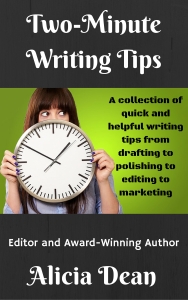
ONLY 99 cents!! 

(Click on the cover to be taken to the Amazon Buy Page)
2 minute writing tip final


 ~*~*~*~*~*~*~*~*~*~*~*~*~*~*~*~*~*~*~*~*

*** If you would like to send me a few sample pages (around 7500 words or so, even though I will not edit that many on the blog. It just gives me more to choose from) for me to edit and share on an upcoming blog post, please do so in the body of an email to AliciaMDean@aol.com. Please use the subject line: “Blog Submission” This is for published or unpublished authors. In the email, please include whether you would like me to use your name or keep it anonymous, and whether or not you would like me to include any contact info or buy info for your books. Also, you can let me know if you would like for me to run my edits by you before posting on the blog. Please keep in mind, this is for samples to use for blog posts. I will not edit or use samples from all the submissions I receive, but I will use as many as possible. 

~*~*~*~*~*~*~*~*~*~*~*~*~*~*~*~*~*~*~*~*
16

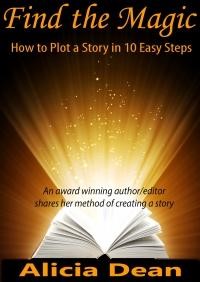
How to write a novel? That is the question. There are probably as many answers to that question as there are people who ask it.

Wanting to write and actually doing it are two very different things. I am well acquainted with the sometimes grueling process of churning out a story. Over the years, I have tried many methods for creating and completing manuscripts, and have tweaked and honed it down to a workable (for me) process.

Using specific examples from one of my own novels, Without Mercy, I share my method in this mini how to book. The first eight steps actually deal with plotting while the last two are designed to help expand your outline into a well-developed draft. There is no one, perfect way to create a story, but there will be a method, or methods that work for you. I’m not sure if this is the one, but it works for me. Only you can decide if it also works for you. Fingers crossed that it does!

*** Warning – Please do not purchase without reading a sample. (This is solid advice for any book, fiction or non. If you are not intrigued in the sample, you will likely not enjoy the book)

Amazon: Click Here
11 Comments

Filed under For Writers, Promo Tips, Tips from an Editor, Tuesday Two-Minute Tips

Tuesday Two-Minute Writing Tip – Loving What You Write

Got two minutes? Then check out this week’s quick tip ~ Writing what you love and loving what you write

Hello and welcome…I am a freelance editor and an editor for The Wild Rose Press, as well as an author. I often struggle with my own writing, and I have found that sometimes, a little reminder of ways to improve the process can be helpful, so, I like to share these moments of brilliance with others :). But, in this busy world of ours, who has time for pages and pages of writing tips? That’s why I’ve condensed mine down to quick flashes you can read in (approximately) two minutes. Enjoy…

TWoMinuteTip

Disclaimer: All of my tips are suggestions, and are only my opinion. And, for the most part, there are exceptions when going against my advice will make your story read better. Take what works, leave the rest.

This is more a reminder than a tip. It’s important to love what you’re writing, for a few reasons. One, if you love your WIP, you’ll look forward to writing and, therefore, accomplish more. Also, if you love it, your joy will show through and readers will be more likely to love it as well. I know that’s not always easy to do, and sometimes writing can be a grind and sometimes a story frustrates and confounds us, but overall, we need to love our work. We don’t always have to love our characters, as a matter of fact, creating characters that are not all that lovable can make a story more interesting. All you have to do is know your characters, although, hopefully, your protagonist is lovable, or at least sympathetic.

Ask yourself these questions about your current WIP:

  1. Is this a story I’d want to read? Why? (if you can’t give a good, solid answer to this one, you might need to rethink at least certain elements of your story)
  2. Do I look forward to picking up where I left off? (If not, readers might not look forward to picking your book back up to read it. Try this trick, at the end of a writing session, jot down a few sentences of something HUGE and shocking that could happen. Even if it’s something that you have no intention of leaving in the book. It can help to invigorate you and make you anxious to get back to your manuscript. And, your mind might, even subconsciously, work on the outrageous idea and turn it into something that actually DOES fit your story but makes it more exciting)
  3. What do I love about this story? Take it a step further and ask yourself what you love about each scene. If you can find something in each one, your readers most likely will too.

That’s it. Just a few things to make you think about your story and whether it’s something that is bringing you entertainment and pleasure, and therefore, can bring the same to readers.

In the comments, tell me one thing you love about a story you are currently writing. For me, it is my Martinic Club 4 1940’s story, and I love that it intertwines with the other three MC4 stories written by my friends, Krysta Scott, Kathy L Wheeler, and Amanda McCabe. Of course, I need to find more than that. And, I will, promise!


Until next time…Happy Writing!

~*~*~*~*~*~*~*~*~*~*~*~*~*~*~*~*~*~*~*~*

ONLY 99 cents!! 

(Click on the cover to be taken to the Amazon Buy Page)

2 minute writing tip final


 ~*~*~*~*~*~*~*~*~*~*~*~*~*~*~*~*~*~*~*~*

*** If you would like to send me a few sample pages (around 7500 words or so, even though I will not edit that many on the blog. It just gives me more to choose from) for me to edit and share on an upcoming blog post, please do so in the body of an email to AliciaMDean@aol.com. Please use the subject line: “Blog Submission” This is for published or unpublished authors. In the email, please include whether you would like me to use your name or keep it anonymous, and whether or not you would like me to include any contact info or buy info for your books. Also, you can let me know if you would like for me to run my edits by you before posting on the blog. Please keep in mind, this is for samples to use for blog posts. I will not edit or use samples from all the submissions I receive, but I will use as many as possible. 

~*~*~*~*~*~*~*~*~*~*~*~*~*~*~*~*~*~*~*~*

16

How to write a novel? That is the question. There are probably as many answers to that question as there are people who ask it.

Wanting to write and actually doing it are two very different things. I am well acquainted with the sometimes grueling process of churning out a story. Over the years, I have tried many methods for creating and completing manuscripts, and have tweaked and honed it down to a workable (for me) process.

Using specific examples from one of my own novels, Without Mercy, I share my method in this mini how to book. The first eight steps actually deal with plotting while the last two are designed to help expand your outline into a well-developed draft. There is no one, perfect way to create a story, but there will be a method, or methods that work for you. I’m not sure if this is the one, but it works for me. Only you can decide if it also works for you. Fingers crossed that it does!

*** Warning – Please do not purchase without reading a sample. (This is solid advice for any book, fiction or non. If you are not intrigued in the sample, you will likely not enjoy the book)

Amazon: Click Here

3 Comments

Filed under For Writers, Promo Tips, Tips from an Editor, Tuesday Two-Minute Tips

Tuesday Two-Minute Writing Tip – Making the Most of Twitter

Got two minutes? Then check out this week’s quick tip ~ A list of handy Twitter tips

Hello and welcome…I am a freelance editor and an editor for The Wild Rose Press, as well as an author. I often struggle with my own writing, and I have found that sometimes, a little reminder of ways to improve the process can be helpful, so, I like to share these moments of brilliance with others :). But, in this busy world of ours, who has time for pages and pages of writing tips? That’s why I’ve condensed mine down to quick flashes you can read in (approximately) two minutes. Enjoy…

TWoMinuteTip

Disclaimer: All of my tips are suggestions, and are only my opinion. And, for the most part, there are exceptions when going against my advice will make your story read better. Take what works, leave the rest.


Tips to get noticed, get retweets, gain followers, or to simply make your Twitter life easier:

  • Although Twitter allows 140 characters, it’s best to not use them all. Shorter tweets are more effective.
  • As everyone knows by now, tweets with images get more notice
  • Ask people to retweet you. The most effective way is to simply add: Please Retweet
  • Use no more than TWO hashtags. More looks spammy
  • Size matters… Images that are smaller than 440 x 222 will not show up in your timeline, only a link to the image does. The max image size is 3MB
  • If you do not want people to tag you without your permission, you can go to your Twitter Privacy settings and specify the tagging you wish to allow. You can remove tags by going to the … ‘more’ beneath a tweet and select ‘remove tag from photo’
  • Use #tweetchat to set up chats by using an exclusive hashtag. I haven’t tried this yet, but I’m going to. Worth a shot, right? http://tweetchat.com/
  • This is more than just a Twitter tip. I’m not sure I understand exactly, but from what I’ve read, it’s worth checking into. It is a service that you can use to trigger actions throughout various web/social media services. It’s more than just linking Facebook and Twitter. There seems to be a number of amazing things you can do with it. IFTTT http://www.pcmag.com/article2/0,2817,2424077,00.asp
  • Did you know Twitter backs up everything you tweet? In settings there is a “Request your archive” option. You will receive an email containing a link to download a ZIP file of your tweets.
  • Track the clicks you get on links you share. Many sites provide this service, for example, Clicktotweet provides full analytics on clicks from your followers. You can also click the Gear icon on Twitter.com and select “Twitter Ads” for a quick look at how many people clicked the links in your recent tweets.
  • To share an image of a tweet on other social media outlets, or blogs, etc, use the ‘embed’ feature. Click on … more and choose ‘embed’ to get the code.   
  • Direct link to FB post or Tweet –  Click the ‘more’ and an option to ‘copy link to tweet’ will come up.
  • Retweet for others frequently. The more you do, the more others are likely to RT you.
  • If you wish to add an image to a composed tweet so that, when others share the tweet (copy and paste the content, not share a link), an image will appear, you’ll want to use Hoosuite. (A tip…I always try to keep all my links somewhere to refer to. Once you have an image link, you can use it over and over again.) Send out a tweet containing the image. Go to Hootsuite and find the tweet in your feed. Below the tweet, find the ‘retweet’ option and click on the drop down arrow. An option will come up to ‘edit.’ Choose that option and your tweet will appear in a box at the top of the page. The very last link in that box should be your image link. Copy that and insert it into a tweet and the image should show up.
  • Find and gain more followers by using http://twiends.com/home
  • Tweet the same content multiple times. The lifespan of a tweet is about 18 minutes. To increase the likelihood of a tweet being seen, tweet out the same tweet multiple times in one day. I wouldn’t do this to several tweets, but if there is something in particular you want to be seen, focus on tweeting it several times. This is when Buffer and Hootsuite will come in handy. You’ll need to make some minor tweaks so you won’t get a message that you’ve already sent that tweet. 
  • Add questions in your retweets and/or tweets to increase engagement and visibility. You can also create polls for more interaction. 
  • I’ll end with a list of the most retweetable words:

You

Twitter

Please

ReTweet

Post

Blog

Social

Free

Media

Help

Please retweet

Great

Social Media

10

Follow

How to

Top

Blog post

Check out

New blog post

(words to avoid, for some reason, ‘Game’, ‘going’, ‘haha’ and ‘lol’)

Until next time…Happy Tweeting!

~*~*~*~*~*~*~*~*~*~*~*~*~*~*~*~*~*~*~*~*

ONLY 99 cents!! 

(Click on the cover to be taken to the Amazon Buy Page)

2 minute writing tip final


 ~*~*~*~*~*~*~*~*~*~*~*~*~*~*~*~*~*~*~*~*

*** If you would like to send me a few sample pages (around 7500 words or so, even though I will not edit that many on the blog. It just gives me more to choose from) for me to edit and share on an upcoming blog post, please do so in the body of an email to AliciaMDean@aol.com. Please use the subject line: “Blog Submission” This is for published or unpublished authors. In the email, please include whether you would like me to use your name or keep it anonymous, and whether or not you would like me to include any contact info or buy info for your books. Also, you can let me know if you would like for me to run my edits by you before posting on the blog. Please keep in mind, this is for samples to use for blog posts. I will not edit or use samples from all the submissions I receive, but I will use as many as possible. 

~*~*~*~*~*~*~*~*~*~*~*~*~*~*~*~*~*~*~*~*

16

How to write a novel? That is the question. There are probably as many answers to that question as there are people who ask it.

Wanting to write and actually doing it are two very different things. I am well acquainted with the sometimes grueling process of churning out a story. Over the years, I have tried many methods for creating and completing manuscripts, and have tweaked and honed it down to a workable (for me) process.

Using specific examples from one of my own novels, Without Mercy, I share my method in this mini how to book. The first eight steps actually deal with plotting while the last two are designed to help expand your outline into a well-developed draft. There is no one, perfect way to create a story, but there will be a method, or methods that work for you. I’m not sure if this is the one, but it works for me. Only you can decide if it also works for you. Fingers crossed that it does!

*** Warning – Please do not purchase without reading a sample. (This is solid advice for any book, fiction or non. If you are not intrigued in the sample, you will likely not enjoy the book)

Amazon: Click Here

8 Comments

Filed under For Writers, Promo Tips, Tips from an Editor, Tuesday Two-Minute Tips

Tuesday Two-Minute Writing Tip – The Backstory Conundrum

Got two minutes? Then check out this week’s quick tip ~ How and when to share backstory 

Hello and welcome…I am a freelance editor and an editor for The Wild Rose Press, as well as an author. I often struggle with my own writing, and I have found that sometimes, a little reminder of ways to improve the process can be helpful, so, I like to share these moments of brilliance with others :). But, in this busy world of ours, who has time for pages and pages of writing tips? That’s why I’ve condensed mine down to quick flashes you can read in (approximately) two minutes. Enjoy…

TWoMinuteTip

Disclaimer: All of my tips are suggestions, and are only my opinion. And, for the most part, there are exceptions when going against my advice will make your story read better. Take what works, leave the rest.

The age old question…how much backstory is too much? The answer… in your opening pages, pretty much ANY backstory is too much. Readers want to be dropped into the middle of the action. They don’t want to know about what a rough week your protagonist has had (we’ll call him Jonathan). How when Jonathan was a child, he  dreamed of being a fireman or an astronaut. But boy did things take a wrong turn. Stuck in a crappy job as an insurance adjuster. He hadn’t wanted to take the position, but his father had recommended him and he had little choice. After all, his father had pretty much controlled him his entire life. A dead-end job and a crappy relationship. Although, he didn’t have to worry about that anymore. His girlfriend had dumped him. They’d been together since college, since the time they met at that party. It had been an immediate attraction. They’d begun dating and hadn’t been apart since. Until two days ago when she told him it was over. That she was seeing someone else. Oh well, they’d drifted apart. It was inevitable. Better that it happened now, instead of when they were married with kids. But, would he ever find the right person? Was there truly one soul mate out there for everyone? If so, he might never meet the person he was meant to be with. Heck, he might not survive the night. Jonathan took a deep, trembling breath and stared at the man aiming a gun at his chest.

What????? He has a gun aimed at his chest and we had to read all that prattle about his job and relationship and past? Nooo….let’s open with the guy holding the gun on him. If any of that other stuff is important, you can trickle it in later. When the situation calls for it.

Many authors, especially beginners, want readers to know everything about their characters up front. It’s not necessary. In fact, it’s boring. You want to engage readers in the here and now. If you want to briefly establish your character in their normal world before the inciting incident, that’s fine. But ‘briefly’ is the key word. And, establishing the character in their normal world is different than explaining about their childhood, letting us know how they met every character in the scene, how they got their job, how they ended up moving to their current location, what happened in the days preceding, etc.

A few examples of my openings (not that they are the BEST examples, but they are the only examples I can use without getting into trouble:)And, unfortunately, neither of them have riveting opening lines, but that’s something I can’t always pull off. Sigh…)

From Devil’s Promenade:

I peered through the snow-dusted windshield at the large house looming in the evening dusk, and an unwarranted shiver of foreboding washed over my flesh.

From behind the wheel, my driver, Rita, made a sound that was somewhere between a squeak of trepidation and a sigh of admiration. “It’s huge. And gorgeous, but kind of creepy, don’t you think?” Her eyes were big and round behind the lenses of her black cat-eye frames.

“It is indeed.” The sprawling structure was a combination of Southern plantation and Greek revival architecture; painted white and trimmed in a darker colored molding—perhaps forest green. The exact color was difficult to make out in the descending dusk. Narrow, darkened floor-to-ceiling windows peeked from between a portico of six Doric columns. Hanging by chains above the porch, a wooden board flapped in the icy wind. Spook Light Bed and Breakfast. The sign should have been welcoming, yet apprehension clawed at my heart.

Might as well get over that silliness. This would be my home for the next two weeks while I learned all I could about the Hornet Spook Light. The phenomenon, also known as the Tri-State Spook Light, Joplin Spook Light, Devil’s Jack-O-Lantern, and a few other nicknames, had supposedly been spotted multiple times over the last few centuries in this area, at the border of Oklahoma, Missouri, and Kansas. I was here to do research for my book—The Myth of Otherworldly Occurrences. I chuckled and rolled my eyes. The only thing otherworldly about this place was its location thousands of miles from my warm, sunny home in Florida.

I gave a brief reason for her being there, but I didn’t say that her fiancé had jilted her for her sister, that she’s always wanted to be a writer, that she actually wanted to write novels, but had ended up writing non-fiction. That the flight to Oklahoma was smooth, except for the annoying man who sat next to her and talked loudly on his phone the entire time and smelled of garlic, that she didn’t have many friends, that she’d written several books already about various supposed supernatural phenomenons, that she was in the business of debunking them, what kind of childhood she had, etc, etc. Some, but not all, of those facts are sprinkled in later. Readers don’t want to know them just yet.

From Without Mercy:

China Beckett darted a glance across the bank lobby toward the front door. What were the odds she could escape undetected?

Not good, she decided. Even if she managed to slip out without being seen, her absence would be noticed. And Sophie would have an aneurysm.

Did she want to be a lousy employee or a lousy mother?

The choice was simple. She rose from her desk and headed past the teller line toward Sophie’s office.

“Everything okay?” China’s best friend, Vanessa Hanson, said from behind her desk.

This establishes China in her normal world, and in just a few pages, it explodes, almost literally. I didn’t go into detail about how she came to be a single mother, how she got the job at the bank, how long she’s been there, what she liked and didn’t like about it, how she’d met Vanessa, what had happened in the days leading up to now, etc. Again, I sprinkle that in as needed, much of it in dialogue. Which brings me to another point, you don’t have to provide details about characters’ history and/or traits in narrative. You can do that in dialogue, which readers often find more engaging. You don’t want to do it in an obvious way, unnatural way, such as, “China, you know your daughter Emma, whose father died while you were pregnant with her? Her asthma is really bad, isn’t it?” 🙂  Reveal it in a more natural and logical way.

But, getting back to backstory. It’s difficult to strike the perfect balance, and I certainly don’t succeed all the time, or even most of the time. The trick is to be aware and try to only share the details that matter at that moment. Save the rest for later, if it’s needed at all.

Try this…go through your story and highlight any section that is not in real time. If your story is riddled with highlights, and if the highlights are in the early pages, you might want to trim and/or move those paragraphs around.

Until next time…Happy Writing!

~*~*~*~*~*~*~*~*~*~*~*~*~*~*~*~*~*~*~*~*

ONLY 99 cents!! 

(Click on the cover to be taken to the Amazon Buy Page)

2 minute writing tip final


 ~*~*~*~*~*~*~*~*~*~*~*~*~*~*~*~*~*~*~*~*

*** If you would like to send me a few sample pages (around 7500 words or so, even though I will not edit that many on the blog. It just gives me more to choose from) for me to edit and share on an upcoming blog post, please do so in the body of an email to AliciaMDean@aol.com. Please use the subject line: “Blog Submission” This is for published or unpublished authors. In the email, please include whether you would like me to use your name or keep it anonymous, and whether or not you would like me to include any contact info or buy info for your books. Also, you can let me know if you would like for me to run my edits by you before posting on the blog. Please keep in mind, this is for samples to use for blog posts. I will not edit or use samples from all the submissions I receive, but I will use as many as possible. 

~*~*~*~*~*~*~*~*~*~*~*~*~*~*~*~*~*~*~*~*

16

How to write a novel? That is the question. There are probably as many answers to that question as there are people who ask it.

Wanting to write and actually doing it are two very different things. I am well acquainted with the sometimes grueling process of churning out a story. Over the years, I have tried many methods for creating and completing manuscripts, and have tweaked and honed it down to a workable (for me) process.

Using specific examples from one of my own novels, Without Mercy, I share my method in this mini how to book. The first eight steps actually deal with plotting while the last two are designed to help expand your outline into a well-developed draft. There is no one, perfect way to create a story, but there will be a method, or methods that work for you. I’m not sure if this is the one, but it works for me. Only you can decide if it also works for you. Fingers crossed that it does!

*** Warning – Please do not purchase without reading a sample. (This is solid advice for any book, fiction or non. If you are not intrigued in the sample, you will likely not enjoy the book)

Amazon: Click Here

9 Comments

Filed under For Writers, Promo Tips, Tips from an Editor, Tuesday Two-Minute Tips

Tuesday Two-Minute Writing Tip – White Space is Your Friend

Got two minutes? Then check out this week’s quick tip ~ A technique to keep readers engaged

Hello and welcome…I am a freelance editor and an editor for The Wild Rose Press, as well as an author. I often struggle with my own writing, and I have found that sometimes, a little reminder of ways to improve the process can be helpful, so, I like to share these moments of brilliance with others :). But, in this busy world of ours, who has time for pages and pages of writing tips? That’s why I’ve condensed mine down to quick flashes you can read in (approximately) two minutes. Enjoy…

TWoMinuteTip

Disclaimer: All of my tips are suggestions, and are only my opinion. And, for the most part, there are exceptions when going against my advice will make your story read better. Take what works, leave the rest.

Readers are impatient, as they should be. Everyone is so busy these days, they want to use their time wisely. Long narrative passages with long paragraphs and no dialogue can turn a reader off quickly. 

This also goes along with ‘showing’ instead of ‘telling.’ Below, I’m using examples from my novella, Devil’s Promenade, showing two different versions of the same partial scene:

Example 1:

That morning at breakfast, I found a newspaper that contained an article about a woman who’d died near the Bed and Breakfast. She was an attractive woman but she gave off an unpleasant vibe in the photo that accompanied the article. As it turned out, the housekeeper at the inn, Jean, knew her. Her name was Eleanor Chaney. The article mentioned that the woman had drowned in nearby Spring River, and her body was found close to Devil’s Promenade. The name of the location confused me. I thought the area itself was called Devil’s Promenade, but as it turns out, that is also the name of a bridge that goes over Spring River. Jean seemed to think Eleanor’s death might not have been an accident. The dead woman grew up in the area and swam in the river often. Yet, she’d gone out, alone, at night. Then somehow drowned. Jean was right. It didn’t add up. I asked Jean if she thought it was suicide, or murder. But according to Jean, while Eleanor was unhappy, she wasn’t suicidal. But then, people never think those they care about could possibly commit suicide. Apparently, the police didn’t find anything suspicious, since they didn’t investigate it as a murder. Shockingly, Jean also informed me that the victim, Eleanor Chaney, was Declan Rush’s sister.

Example 2:

“Something catch your fancy?”

I started at Jean’s voice. My hand that held the coffee cup shook. “Sorry to be so jumpy. No, just engrossed in the news.” Should I ask her about the death? Maybe not just yet, not on my first morning. I didn’t want to seem like a nosy reporter, or that I was pumping her for information. She most likely knew the woman. This was a small town. Most people in the area probably knew one another.

Jean took the decision out of my hands when she eyed the paper. She wiped tears from her eyes with her fingertips. “Poor dear. God rest her soul.”

“Did you know her?”

“Yes of course. Eleanor Chaney. We were real close.”

I looked back down at the paper. A photo of the woman accompanied the article. She was attractive, but her expression showed an unpleasant emotion—anger, disapproval? Without it, she would have been much prettier. “She drowned in Spring River,” I said. “They said her body was found near Devil’s Promenade? I thought this area was called Devil’s Promenade.”

“It is. But it’s also the name of a bridge that goes over Spring River.”

The name made the death…the whole thing…even worse, somehow. “So tragic.”

“Yeah. They say it was an accident but …” She heaved a deep breath. “I don’t know. I wonder how that could be. She grew up swimmin’ in that river. And I don’t believe she’d go in the water alone, at night.”

A quiver ran through me. “Do you think it was suicide? Murder?”

Jean lowered onto a chair next to me and picked up the newspaper. She ran a finger lovingly over the picture, a sad smile on her wrinkled face. “Eleanor was not one of the happiest people I’ve ever known, but she thought too much of herself to commit suicide. I don’t buy that she’d take her own life.”

“So you think someone killed her?”

“I don’t know. The thought makes my skin crawl. This is a small town. Everyone knows each other. Eleanor wasn’t exactly well loved. And, her family history caused some hard feelings around here, but I don’t know anyone who hated her. Leastwise not enough to want her dead.”

Was Jean right? Had the woman been murdered? Surely if that were true, there would have been evidence pointing to foul play. “Well, either way, accident, murder, or suicide, it’s very sad.”

“Yes. And poor Mr. Rush. He’s beside himself.”

“Mr. Rush? He knew her too?” Was she his girlfriend? Not his wife, their last names were different. But then, not all women took their husband’s names…

“Knew her? Well, I’ll say. She was his sister.”

Which did you find yourself wanting to skip and which one kept you reading? When you’re editing/revising, skim your manuscript and if you see areas with little or no white space, take a closer look and see if you can revise to make them more engaging.

Until next time…Happy Writing!

~*~*~*~*~*~*~*~*~*~*~*~*~*~*~*~*~*~*~*~*

ONLY 99 cents!! 

(Click on the cover to be taken to the Amazon Buy Page)

2 minute writing tip final


 ~*~*~*~*~*~*~*~*~*~*~*~*~*~*~*~*~*~*~*~*

*** If you would like to send me a few sample pages (around 7500 words or so, even though I will not edit that many on the blog. It just gives me more to choose from) for me to edit and share on an upcoming blog post, please do so in the body of an email to AliciaMDean@aol.com. Please use the subject line: “Blog Submission” This is for published or unpublished authors. In the email, please include whether you would like me to use your name or keep it anonymous, and whether or not you would like me to include any contact info or buy info for your books. Also, you can let me know if you would like for me to run my edits by you before posting on the blog. Please keep in mind, this is for samples to use for blog posts. I will not edit or use samples from all the submissions I receive, but I will use as many as possible. 

~*~*~*~*~*~*~*~*~*~*~*~*~*~*~*~*~*~*~*~*

16

How to write a novel? That is the question. There are probably as many answers to that question as there are people who ask it.

Wanting to write and actually doing it are two very different things. I am well acquainted with the sometimes grueling process of churning out a story. Over the years, I have tried many methods for creating and completing manuscripts, and have tweaked and honed it down to a workable (for me) process.

Using specific examples from one of my own novels, Without Mercy, I share my method in this mini how to book. The first eight steps actually deal with plotting while the last two are designed to help expand your outline into a well-developed draft. There is no one, perfect way to create a story, but there will be a method, or methods that work for you. I’m not sure if this is the one, but it works for me. Only you can decide if it also works for you. Fingers crossed that it does!

*** Warning – Please do not purchase without reading a sample. (This is solid advice for any book, fiction or non. If you are not intrigued in the sample, you will likely not enjoy the book)

Amazon: Click Here

16 Comments

Filed under For Writers, Promo Tips, Tips from an Editor, Tuesday Two-Minute Tips

Tuesday Two-Minute Writing Tip – Ten Writing Tips from Famous Authors

Got two minutes? Then check out this week’s quick tip ~ A collection of some of my favorite writing advice

Hello and welcome…I am a freelance editor and an editor for The Wild Rose Press, as well as an author. I often struggle with my own writing, and I have found that sometimes, a little reminder of ways to improve the process can be helpful, so, I like to share these moments of brilliance with others :). But, in this busy world of ours, who has time for pages and pages of writing tips? That’s why I’ve condensed mine down to quick flashes you can read in (approximately) two minutes. Enjoy…

TWoMinuteTip

Disclaimer: All of my tips are suggestions, and are only my opinion. And, for the most part, there are exceptions when going against my advice will make your story read better. Take what works, leave the rest.

Today I’m sharing tips from people who know a little something about writing. Not only are these valuable tips, but being reminded that even the most successful authors suffer from some of the same issues I do gives me the encouragement to forge on.

  1. Imagine that you are dying. If you had a terminal disease would you finish this book? Why not? The thing that annoys this 10-weeks-to-live self is the thing that is wrong with the book. So change it. Stop arguing with yourself. Change it. See? Easy. And no one had to die.– Anne Enright 

I love this one because it makes you stop and think about whether you want to waste time writing to a trend and/or forcing yourself to write something that doesn’t speak to you, doesn’t inspire you. I say, you do not.

  1. Remember: when people tell you something’s wrong or doesn’t work for them, they are almost always right. When they tell you exactly what they think is wrong and how to fix it, they are almost always wrong.– Neil Gaiman 

This doesn’t count your editors…you should always listen to us. 😉

  1. Write drunk, edit sober.– Ernest Hemingway

Although I think several writers take this literally, to me it means to write with abandon, lose your inhibitions, write freely and just get the story down. 

  1. Substitute ‘damn’ every time you’re inclined to write ‘very;’ your editor will delete it and the writing will be just as it should be.– Mark Twain

Yes, using ‘very’ is one of my pet peeves. It’s okay in dialogue, and perhaps used sparingly, but it’s ineffectual and weak. If you’re using it, you could probably substitute the following word for something stronger.

  1.  “The first draft of everything is shit.” – Ernest Hemingway

This doesn’t apply to all you perfectionists who have to get every scene just right before moving on. But, for those of us who need to just finish the damn book so we can begin revising, this is critical. If Ernest Hemingway wrote shit, then we’re not too good to write shit, correct? 

  1. “Don’t tell me the moon is shining; show me the glint of light on broken glass.” – Anton Chekhov 

LOVE this. It’s an excellent way to remind yourself to ‘show’ instead of ‘tell.’

  1. “Keep your exclamation points under control. You are allowed no more than two or three per 100,000 words of prose.” Elmore Leonard

Thank you!!! The overuse of exclamation points in fiction drive me nuts. Readers will know they’re experiencing an intense moment by the emotion, dialogue, and action. Don’t hit them over the head with exclamation points.

  1. “If you tell the reader that Bull Beezley is a brutal-faced, loose-lipped bully, with snake’s blood in his veins, the reader’s reaction may be, ‘Oh, yeah!’ But if you show the reader Bull Beezley raking the bloodied flanks of his weary, sweat-encrusted pony, and flogging the tottering, red-eyed animal with a quirt, or have him booting in the protruding ribs of a starved mongrel and, boy, the reader believes!” – Fred East

Another fabulous tip for showing vs telling. This one deals with character rather than setting, and showing vs telling is important enough to get two mentions. 🙂

  1. “You don’t write about the horrors of war. No. You write about a kid’s burnt socks lying in the road.” ― Richard Price

To me this means a few things, make it personal. Make us care about something because of the characters involved. Also, show us little vivid details to really bring the scene to life.

10. “Good writing is often about letting go of fear and affectation.” Stephen King

YES. I often let fear stop me, but I need to remind myself not to. Also, the simplest, most direct and natural way you can convey a story is the right way. That’s your voice.

What are some of your favorite tips from famous authors?

Until next time…Happy Writing!

~*~*~*~*~*~*~*~*~*~*~*~*~*~*~*~*~*~*~*~*

ONLY 99 cents!! 

(Click on the cover to be taken to the Amazon Buy Page)

2 minute writing tip final


 ~*~*~*~*~*~*~*~*~*~*~*~*~*~*~*~*~*~*~*~*

*** If you would like to send me a few sample pages (around 7500 words or so, even though I will not edit that many on the blog. It just gives me more to choose from) for me to edit and share on an upcoming blog post, please do so in the body of an email to AliciaMDean@aol.com. Please use the subject line: “Blog Submission” This is for published or unpublished authors. In the email, please include whether you would like me to use your name or keep it anonymous, and whether or not you would like me to include any contact info or buy info for your books. Also, you can let me know if you would like for me to run my edits by you before posting on the blog. Please keep in mind, this is for samples to use for blog posts. I will not edit or use samples from all the submissions I receive, but I will use as many as possible. 

~*~*~*~*~*~*~*~*~*~*~*~*~*~*~*~*~*~*~*~*

16

How to write a novel? That is the question. There are probably as many answers to that question as there are people who ask it.

Wanting to write and actually doing it are two very different things. I am well acquainted with the sometimes grueling process of churning out a story. Over the years, I have tried many methods for creating and completing manuscripts, and have tweaked and honed it down to a workable (for me) process.

Using specific examples from one of my own novels, Without Mercy, I share my method in this mini how to book. The first eight steps actually deal with plotting while the last two are designed to help expand your outline into a well-developed draft. There is no one, perfect way to create a story, but there will be a method, or methods that work for you. I’m not sure if this is the one, but it works for me. Only you can decide if it also works for you. Fingers crossed that it does!

*** Warning – Please do not purchase without reading a sample. (This is solid advice for any book, fiction or non. If you are not intrigued in the sample, you will likely not enjoy the book)

Amazon: Click Here
16 Comments

Filed under For Writers, Promo Tips, Tips from an Editor, Tuesday Two-Minute Tips

Tuesday Two-Minute Writing Tip – Fabulous Ebook Contest – International Digital Awards

Got two minutes? Then check out this week’s quick tip ~ Enter your book in OKRWA’s IDA Contest for more exposure and a chance to win awesome prizes!

Hello and welcome…I am a freelance editor and an editor for The Wild Rose Press, as well as an author. I often struggle with my own writing, and I have found that sometimes, a little reminder of ways to improve the process can be helpful, so, I like to share these moments of brilliance with others :). But, in this busy world of ours, who has time for pages and pages of writing tips? That’s why I’ve condensed mine down to quick flashes you can read in (approximately) two minutes. Enjoy…

TWoMinuteTip

Disclaimer: All of my tips are suggestions, and are only my opinion. And, for the most part, there are exceptions when going against my advice will make your story read better. Take what works, leave the rest.

I am not feeling well today, plus, I am involved in the Candace Havens Fast Draft process with three of my writer friends, so my brain power is somewhat used up. 🙂 Instead of an actual tip, I thought I would tell you about a contest you should seriously consider entering. This is the fifth year OKRWA has hosted the International Digital Awards. I was one of the co-founders of the contest, and it has been quite successful for our chapter and for entrants.

Why should you enter? Let me tell you…

The IDA accepts Ebook entries in 7 different categories, both novel (40,000 words and above) and novella/short (10,000 to 39,999 words) lengths. Each entry is seen by three different readers, so even if you don’t place, you have the opportunity of reaching new readers.

The entry fee is low…$20 for novel length, $15 for novella/short length.

If you DO place, you receive a nice paper certificate and button for your website. Plus, your information goes up on our website.

If you WIN, you receive the following…

  • This awesome engraved paperweight (updated with YOUR info of course :)) **colors my vary

Novel Paperweight prize Short-Novella paperweight prize

  • You will be featured on a minimum of 3 blog posts

  • Your book will be featured in a “winner” video trailer that will be shared on FB, tweeted, and featured on at least 3 blogs and websites

  • Multiple Tweets and Facebook posts 

  • Featured on a special IDA Winners Pinterest Page

Why wouldn’t you want to enter??? 

Get those entries in soon…the deadline is June 30, 2016.

Detailed information on entering can be found here:

FMI: https://okrwa.com/contests/international-digital-awards/contest-categories/


Eligibility: Any ebook with an original copyright date of 2015 or 2016 that was eligible for sale in 2015 or 2016 and is NOT available for purchase in mass print by April 15, 2016 (Ebooks that are available as POD’s are eligible)

Entry: Non DRM PDF as email attachment

Categories: (All of the following offer BOTH a short/novella and a Novel category in each genre – Entries may contain romance, but romance is not required)

  • Contemporary

  • Erotica

  • Historical

  • Inspirational

  • Paranormal

  • Suspense

  • Young Adult

We need judges too! If you wish to judge, check out the information here: (You are free to judge, even if you enter, as long as you judge a category other than the one you enter)

https://okrwa.com/contests/international-digital-awards/judging-information/

Judges: Readers, including other unpublished and published authors.

Comments from past entrants:

  • This is an awesome contest! Not only did I receive recognition by winning the historical category, but I also received support in the form of tweets, Facebook posts and reviews from the judges. It was such an honor to have won such a prestigious contest. Thank you IDA! ~ Laurel O’Donnell, Award Winning Author of Angel’s Assassin

  • “Oh. My. Goodness! If there’s one contest you do not want to miss entering, it’s OKRWA’s International Digital Awards. As a winner in the 2013 IDA, I can honestly say that I have never gotten more bang for my contest buck than I have with the IDA: a website winner’s icon, a paperweight award, Facebook and Twitter promotion, reviews posted on Amazon and Goodreads by judges and IDA personnel along with Twitter and FB postings, plus a list of review links. Are you kidding me? No other contest does this and the icing on the cake? The IDA coordinators are AWESOME!! ~– Julie Lessman, award-winning author of The Daughters of Boston and Winds of Change series

  • “High praise for the International Digital Awards contest. Right on the mark with tons of terrific, highly-visible, effective promotions for winners.” ~Timothy Davis, author of SEA CUTTER

  • “What a wonderful contest! I’ve long admired the NRCA and read many of the winners. So glad OKRWA has created a digital award. The prize is mighty sweet as well. I appreciate the exposure to new digital readers that the IDA has given STONE KISSED.” ~Keri Stevens, author

  • “I am so glad that your hard-working chapter will continue with the International Digital Awards next year. I know it’s a lot of work — but so appreciated. Winning the IDA has been a thrill for me.” ~Cheryl Bolen, author of MY LORD WICKED

So…hurry up and get those entries in…best of luck!

Until next time…happy writing!

Oh yes, I wanted to share this boxed set, on sale for ONLY 99¢ – Six past IDA winners got together and released their winning stories in this boxed set. Genres include Contemporary Romance, Paranormal, Suspense, Historical,  and Young Adult. Check out it:

51UU92O-exL._SY331_BO1,204,203,200_

Amazon Buy Link: https://amzn.com/B01F9RHLE6

 ~*~*~*~*~*~*~*~*~*~*~*~*~*~*~*~*~*~*~*~*

NEW RELEASE – Now Available 

(Click on the cover to be taken to the Amazon Buy Page)

2 minute writing tip final


 ~*~*~*~*~*~*~*~*~*~*~*~*~*~*~*~*~*~*~*~*

*** If you would like to send me a few sample pages (around 7500 words or so, even though I will not edit that many on the blog. It just gives me more to choose from) for me to edit and share on an upcoming blog post, please do so in the body of an email to AliciaMDean@aol.com. Please use the subject line: “Blog Submission” This is for published or unpublished authors. In the email, please include whether you would like me to use your name or keep it anonymous, and whether or not you would like me to include any contact info or buy info for your books. Also, you can let me know if you would like for me to run my edits by you before posting on the blog. Please keep in mind, this is for samples to use for blog posts. I will not edit or use samples from all the submissions I receive, but I will use as many as possible. 

~*~*~*~*~*~*~*~*~*~*~*~*~*~*~*~*~*~*~*~*

16

How to write a novel? That is the question. There are probably as many answers to that question as there are people who ask it.

Wanting to write and actually doing it are two very different things. I am well acquainted with the sometimes grueling process of churning out a story. Over the years, I have tried many methods for creating and completing manuscripts, and have tweaked and honed it down to a workable (for me) process.

Using specific examples from one of my own novels, Without Mercy, I share my method in this mini how to book. The first eight steps actually deal with plotting while the last two are designed to help expand your outline into a well-developed draft. There is no one, perfect way to create a story, but there will be a method, or methods that work for you. I’m not sure if this is the one, but it works for me. Only you can decide if it also works for you. Fingers crossed that it does!

*** Warning – Please do not purchase without reading a sample. (This is solid advice for any book, fiction or non. If you are not intrigued in the sample, you will likely not enjoy the book)

Amazon: Click Here
1 Comment

Filed under For Writers, Promo Tips, Tips from an Editor, Tuesday Two-Minute Tips

Tuesday Two-Minute Writing Tips – Characters Who Talk to Themselves

Got two minutes? Then check out this week’s quick tip ~ Advice on using a character’s first person, internal thoughts sparingly.

Hello and welcome…I am a freelance editor and an editor for The Wild Rose Press, as well as an author. I often struggle with my own writing, and I have found that sometimes, a little reminder of ways to improve the process can be helpful, so, I like to share these moments of brilliance with others :). But, in this busy world of ours, who has time for pages and pages of writing tips? That’s why I’ve condensed mine down to quick flashes you can read in (approximately) two minutes. Enjoy…


TWoMinuteTip

Disclaimer: All of my tips are suggestions, and are only my opinion. And, for the most part, there are exceptions when going against my advice will make your story read better. Take what works, leave the rest.

It’s easy to fall into the trap of allowing your characters to talk to themselves too frequently, especially when you are trying to write in ‘Deep POV.’ However, deep POV doesn’t really mean using a lot of italicized first person thoughts. You can write in deep POV by connecting with a character’s emotions and avoiding filter words. But, if you have characters talk to themselves too often, it can be distracting and make your characters seem a bit unstable. 🙂

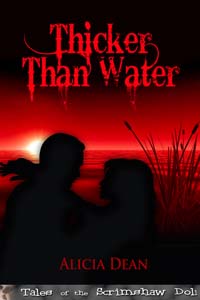
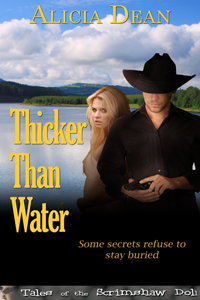
Here are some examples from my short story, Thicker than Water (I’m using this as an example as an excuse to share my new cover, which I love…see below):

This is Julia’s POV:

“Julia?” The voice came from her right, and even before she turned, she recognized the owner. No way could she mistake the smooth, deep baritone, tinged with that slight Okie drawl. A sound that had always reminded her of honey oozing over a warm biscuit.

Jake Devlin.

Heart threatening to explode from her chest, she inhaled, then exhaled a slow, steady breath, before she turned to face him. Somehow, he seemed taller than she remembered. He wore cowboy boots and a battered Stetson with a chocolate-brown uniform shirt tucked into blue jeans.

That felt pretty much like deep POV, don’t you think? We could feel what she felt, we knew her emotions. I might have been tempted to write it like this:

“Julia?” The voice came from her right, and even before she turned, she recognized the owner. No way could I mistake the smooth, deep baritone, tinged with that slight Okie drawl. It has always reminded me of honey oozing over a warm biscuit.

Jake Devlin.

My heart is going to explode from my chest. Breathe, in, out, slow and steady. She turned to face him. He’s taller than I remember.  He wore cowboy boots and a battered Stetson with a chocolate-brown uniform shirt tucked into blue jeans.

Here is a scene from Jake’s POV. For some reason, male characters talking to themselves seems worse that female. Probably because, normally, men don’t talk that much anyway.

Normally, watching the Sox take the Yankees down would have Jake riveted to the television, but he could barely concentrate. All he could think about was Julia.

How could he even be around her with the burden of the secret he carried?

Knowing the truth would crush her. Not telling her would damn him to an eternity of torment. He owed her the truth. The truth would kill her.

Back and forth, his thoughts circled and collided with one another. He needed to solve this damned case, so she’d get the hell out of town. That way, he wouldn’t be forced to hold back any secrets. He could carry it all on his own.

Doesn’t that work better than if I’d done this?

Normally, watching the Sox take the Yankees down would have Jake riveted to the television, but he could barely concentrate. All I can think about is Julia.

How can I even be around her with the burden of the secret I’m carrying?

Knowing the truth will crush her. Not telling her will damn me to an eternity of torment. You owe her the truth. The truth will kill her.

Back and forth, his thoughts circled and collided with one another. I need to solve this damned case, so she’ll get the hell out of town. That way, I won’t be forced to hold back any secrets. I can carry it all on my own.

So, can you see how you can write a scene with internal thoughts, yet not have them first person, italicized thoughts, which can be a little distracting?

And now, for my revised cover for Thicker than Water…First, the previous one:

11. THICKER THAN WATER 8.12

The new one…

perf5.000x8.000.indd

What do you think? Better? I modeled my hero after Raylan Givens from Justified, and I think this cover captures him much better.

Until next time…happy writing!

 ~*~*~*~*~*~*~*~*~*~*~*~*~*~*~*~*~*~*~*~*

NEW RELEASE – Now Available (and still 99 cents for a brief time!!!)

(Click on the cover to be taken to the Amazon Buy Page)

2 minute writing tip final


 ~*~*~*~*~*~*~*~*~*~*~*~*~*~*~*~*~*~*~*~*

*** If you would like to send me a few sample pages (around 7500 words or so, even though I will not edit that many on the blog. It just gives me more to choose from) for me to edit and share on an upcoming blog post, please do so in the body of an email to AliciaMDean@aol.com. Please use the subject line: “Blog Submission” This is for published or unpublished authors. In the email, please include whether you would like me to use your name or keep it anonymous, and whether or not you would like me to include any contact info or buy info for your books. Also, you can let me know if you would like for me to run my edits by you before posting on the blog. Please keep in mind, this is for samples to use for blog posts. I will not edit or use samples from all the submissions I receive, but I will use as many as possible. 

~*~*~*~*~*~*~*~*~*~*~*~*~*~*~*~*~*~*~*~*

16

How to write a novel? That is the question. There are probably as many answers to that question as there are people who ask it.

Wanting to write and actually doing it are two very different things. I am well acquainted with the sometimes grueling process of churning out a story. Over the years, I have tried many methods for creating and completing manuscripts, and have tweaked and honed it down to a workable (for me) process.

Using specific examples from one of my own novels, Without Mercy, I share my method in this mini how to book. The first eight steps actually deal with plotting while the last two are designed to help expand your outline into a well-developed draft. There is no one, perfect way to create a story, but there will be a method, or methods that work for you. I’m not sure if this is the one, but it works for me. Only you can decide if it also works for you. Fingers crossed that it does!

*** Warning – Please do not purchase without reading a sample. (This is solid advice for any book, fiction or non. If you are not intrigued in the sample, you will likely not enjoy the book)

Amazon: Click Here

4 Comments

Filed under For Writers, Promo Tips, Tips from an Editor, Tuesday Two-Minute Tips

Tuesday Two-Minute Writing Tip/Vent – Sometimes, Even the Big Guns Misfire

Got two minutes? Then check out this week’s quick…rant ~  Recurring missteps by famous, successful authors…

Hello and welcome…I am a freelance editor and an editor for The Wild Rose Press, as well as an author. I often struggle with my own writing, and I have found that sometimes, a little reminder of ways to improve the process can be helpful, so, I like to share these moments of brilliance with others :). But, in this busy world of ours, who has time for pages and pages of writing tips? That’s why I’ve condensed mine down to quick flashes you can read in (approximately) two minutes. Enjoy…

TWoMinuteTip

Disclaimer: All of my tips are suggestions, and are only my opinion. And, for the most part, there are exceptions when going against my advice will make your story read better. Take what works, leave the rest.

Rather than ‘tips,’ per se, I just want to point out/vent a little about how lesser known authors, especially Indy authors, are held to such high standards and picked apart for every little error. Yet, almost every time I read a book, even by the most successful and well-known authors, I am pulled out of the story by errors and poorly executed prose. I know that being an author and editor myself, I notice things the average reader doesn’t but I just have to think, these writers are in the big time, can’t they put a little more care and finesse into their work? (Having said all of that, I am WELL aware that my writing is far from excellent and error-free, but I admit it, own it, am still working to improve, and I am not a millionaire NYT best-selling author).

I won’t name names, but I would like to share some issues I’ve found with some of the recent books I’ve read…

The first one is a suspense by a male author that I LOVE, and I am usually captivated by his books.

Problem 1:

The main character (we’ll call her Suzie), made it clear, early in the book, pretty much on the first page, that she thought very little of her former brother-in-law (her dead sister’s husband), and his fathering capabilities. As a matter of fact, when BIL offers his condolences over the death of Suzie’s husband, and asks if there is anything he can do, she has the thought, you can take better care of your children

Then, at the end of the book, Suzie plans to sacrifice her life in order to bring murderers to justice. Before she dies, she sets it up so BIL will be the one to raise her two-year-old daughter. HUH???? He sucks as a parent, yet HE is the one to whom you entrust your daughter?

Problem 2:

I’ve noticed this with a lot of the ‘big’ guys and gals…distant writing. I’ll give you a few examples. We’ll call Suzie’s daughter Shelly. And we’ll call Suzie’s friend Mark. In a scene where Mark was holding Shelly in his arms, and we are in Suzie’s POV, we have this narrative:

The little girl laid her head on Mark’s shoulder…

(I’m thinking…the little girl??? Wait, I thought he was holding Shelly. You know, your daughter, who you know quite well, well enough not to refer to her as ‘the little girl’)

And another line:

Shelly looked at her mother…

(Wait, I thought YOU were her mother)

This sort of thing appeared several times in another book I read recently by one of my favorite male authors. The MC had a teenaged daughter (who was a BRAT, by the way), and we are in her father’s POV. Lines like this appeared regularly:

Brittney seldom listened to her father.

(Yeah, well, she seldom listens to you either!)

Problem 3:

(There were actually several plot holes, in my opinion, implausible actions, etc, but I won’t go into all that, I’ll just focus on one issue in particular.) This sort of thing really bothers me, although many authors seem to think it’s okay…

Cheating the reader. DON’T do it!!! In this case, the book starts out at the funeral of Suzie’s husband who had been shot by thugs when she and her husband were at a park together a few nights earlier. The ENTIRE book is in Suzie’s POV. We go through this big long mystery and cat and mouse kind of thing, several interviews with the police, etc, etc, her internal thoughts about the night the murder happened, about her marriage, her daughter, about what’s going on now and who and why it’s happening, etc, etc. Well, guess what we find out at the end of the story? SHE killed her husband. On purpose. Shot him down. Dead. In the entire book, not once did her internal thoughts wander to that little bit of information. That’s not a twist, it’s a major cheat. Since she knew she killed her husband, and we were privy to her thoughts during the entire book, at least ONE of those thoughts should have been about how she KILLED her husband! Am I right?

Problem 4:

Something minor, but it still didn’t sit right with me. She is speaking with a detective who is asking her some questions that indicate he’s a little suspicious of her. They are discussing the weapon that killed her husband, and she says, “Are you familiar with revolvers, Detective?” And he says, “No.” and she goes on to explain the difference between revolvers and semi-automatics, or something like that. Uh, I’m sorry, but a seasoned homicide detective who isn’t familiar with revolvers?? Nope, not buying it. (She is a former soldier, so she was an expert…on everything.)

Another book by a female author who has published a series of probably 20 books about this same MC (and the MC is very unlikable, BTW, I couldn’t finish Book 1, I wanted to punch her the whole time, and I figured that probably wasn’t very healthy)

Anyway, this MC is a woman who worked closely with the police, frequently, and for years, and her best friend is a detective and she is literally THE BEST in her field, that was made painfully and repeatedly obvious. Someone violently vandalized her studio. The perpetrator killed her neighbor’s cat and smeared cat blood all over the destroyed room. The cat’s body was still there. She calls the police, then while waiting for them, she takes the cat’s body over to its owner. REALLY???? You are so intelligent and know everything about the law, yet you removed a vital piece of evidence–and, technically, the VICTIM–from a crime scene?

Okay, I’m done. Sorry. I don’t mean to be critical, and I don’t know if anyone will learn anything from this, but it was on my mind. And now it’s off my chest, so I feel better. 🙂

Until next time…happy writing!

 ~*~*~*~*~*~*~*~*~*~*~*~*~*~*~*~*~*~*~*~*

NEW RELEASE – Now Available 

(Click on the cover to be taken to the Amazon Buy Page)

2 minute writing tip final


 ~*~*~*~*~*~*~*~*~*~*~*~*~*~*~*~*~*~*~*~*

*** If you would like to send me a few sample pages (around 7500 words or so, even though I will not edit that many on the blog. It just gives me more to choose from) for me to edit and share on an upcoming blog post, please do so in the body of an email to AliciaMDean@aol.com. Please use the subject line: “Blog Submission” This is for published or unpublished authors. In the email, please include whether you would like me to use your name or keep it anonymous, and whether or not you would like me to include any contact info or buy info for your books. Also, you can let me know if you would like for me to run my edits by you before posting on the blog. Please keep in mind, this is for samples to use for blog posts. I will not edit or use samples from all the submissions I receive, but I will use as many as possible. 

~*~*~*~*~*~*~*~*~*~*~*~*~*~*~*~*~*~*~*~*

16

How to write a novel? That is the question. There are probably as many answers to that question as there are people who ask it.

Wanting to write and actually doing it are two very different things. I am well acquainted with the sometimes grueling process of churning out a story. Over the years, I have tried many methods for creating and completing manuscripts, and have tweaked and honed it down to a workable (for me) process.

Using specific examples from one of my own novels, Without Mercy, I share my method in this mini how to book. The first eight steps actually deal with plotting while the last two are designed to help expand your outline into a well-developed draft. There is no one, perfect way to create a story, but there will be a method, or methods that work for you. I’m not sure if this is the one, but it works for me. Only you can decide if it also works for you. Fingers crossed that it does!

*** Warning – Please do not purchase without reading a sample. (This is solid advice for any book, fiction or non. If you are not intrigued in the sample, you will likely not enjoy the book)

Amazon: Click Here

12 Comments

Filed under For Writers, Promo Tips, Tips from an Editor, Tuesday Two-Minute Tips

Tuesday Two-Minute Writing Tip – Miscellaneous Tips You Can’t Live Without

Got two minutes? Then check out this week’s quick tip ~ A handful of editing, writing, and marketing tips to make your life easier…

Hello and welcome…I am a freelance editor and an editor for The Wild Rose Press, as well as an author. I often struggle with my own writing, and I have found that sometimes, a little reminder of ways to improve the process can be helpful, so, I like to share these moments of brilliance with others :). But, in this busy world of ours, who has time for pages and pages of writing tips? That’s why I’ve condensed mine down to quick flashes you can read in (approximately) two minutes. Enjoy…

TWoMinuteTip

Disclaimer: All of my tips are suggestions, and are only my opinion. And, for the most part, there are exceptions when going against my advice will make your story read better. Take what works, leave the rest.

Here are a few things I’ve learned along the way that have been helpful to me, and I’m hoping they will be to you also…

Writing Habit:

I know it’s very difficult to carve out writing time each day. Writers need a large chunk of time to be ‘in the zone’ and undisturbed. However, if you want to work toward a habit of writing each day, try to make yourself write one paragraph a day. The advantages are…

  • At least you’re writing SOMETHING, and a trickle can become a stream
  • You might be surprised at how much more than just that one paragraph you are able to write
  • If you’re like me and you have scene notes but don’t have a good handle on exactly how the scene will play out, writing a paragraph about what you DO know can serve as a placeholder and when you go back later, your scene might flow. Or you might determine it should be cut. Either way, you can resolve that particular scene. If you keep doing this, you can build a nice outline for your novel

‘Word’ tips:

I’m sure you’ve all seen those squiggly blue and red lines that indicate, according to ‘Word,’ you’ve made a booboo? Did you know that there is an option where you can actually be taken to each of these potential errors? Under ‘Review’ you should see an option for ‘ABC ✔ Spelling and Grammar.’ If you click on that, it will take you to each instance of errors and you will have the option to correct them or ignore. It doesn’t find ALL typos and mistakes, but it finds many.

Word also has a ‘Compare’ function in the Review section that comes in handy if you can’t recall which version of two documents is the most recent, or if, for any reason, you wish to compare the differences in two documents. Once you click on ‘compare’ it’s self-explanatory.

Facebook and Twitter:

When you draft a Facebook post, before actually posting, you can delete the actual link and just leave the content and image to make your post look a bit ‘cleaner’ and the option to click on where the link leads will remain in your post.

You can schedule posts  to your ‘page’ ahead of time on Facebook. Once you draft a post, click on the arrow next to ‘publish’ found beneath your content box. An option for scheduling will come up. You can schedule a week’s worth of posts at one sitting.

You can embed tweets for sharing rather than screen-shotting them. Beneath your tweet, you will see the … option. If you click on that, one of the options that comes up is to ’embed’ your tweet. Copy and paste that link.

If you wish to share a link for a Facebook post or a Tweet, you can get a direct link by clicking on the time/day of the post/tweet. A new page will come up that will contain the direct link in the search bar. Copy and paste. This is handy if you want to ask others to share a tweet or post for you, or if you want to, say post a link from your fan page into your profile page, etc.

That’s it for now…just a few little bite-sized tips. Hope you find them useful!

Until next time…happy writing!

 ~*~*~*~*~*~*~*~*~*~*~*~*~*~*~*~*~*~*~*~*

NEW RELEASE – Now Available 

(Click on the cover to be taken to the Amazon Buy Page)

2 minute writing tip final


 ~*~*~*~*~*~*~*~*~*~*~*~*~*~*~*~*~*~*~*~*

*** If you would like to send me a few sample pages (around 7500 words or so, even though I will not edit that many on the blog. It just gives me more to choose from) for me to edit and share on an upcoming blog post, please do so in the body of an email to AliciaMDean@aol.com. Please use the subject line: “Blog Submission” This is for published or unpublished authors. In the email, please include whether you would like me to use your name or keep it anonymous, and whether or not you would like me to include any contact info or buy info for your books. Also, you can let me know if you would like for me to run my edits by you before posting on the blog. Please keep in mind, this is for samples to use for blog posts. I will not edit or use samples from all the submissions I receive, but I will use as many as possible. 

~*~*~*~*~*~*~*~*~*~*~*~*~*~*~*~*~*~*~*~*

16

How to write a novel? That is the question. There are probably as many answers to that question as there are people who ask it.

Wanting to write and actually doing it are two very different things. I am well acquainted with the sometimes grueling process of churning out a story. Over the years, I have tried many methods for creating and completing manuscripts, and have tweaked and honed it down to a workable (for me) process.

Using specific examples from one of my own novels, Without Mercy, I share my method in this mini how to book. The first eight steps actually deal with plotting while the last two are designed to help expand your outline into a well-developed draft. There is no one, perfect way to create a story, but there will be a method, or methods that work for you. I’m not sure if this is the one, but it works for me. Only you can decide if it also works for you. Fingers crossed that it does!

*** Warning – Please do not purchase without reading a sample. (This is solid advice for any book, fiction or non. If you are not intrigued in the sample, you will likely not enjoy the book)

Amazon: Click Here

5 Comments

Filed under For Writers, Promo Tips, Tips from an Editor, Tuesday Two-Minute Tips