
Please help me welcome today’s guest, Paul Michael Durivage with an excellent article on craft:
What a Character Packs Before They Know They Are Leaving
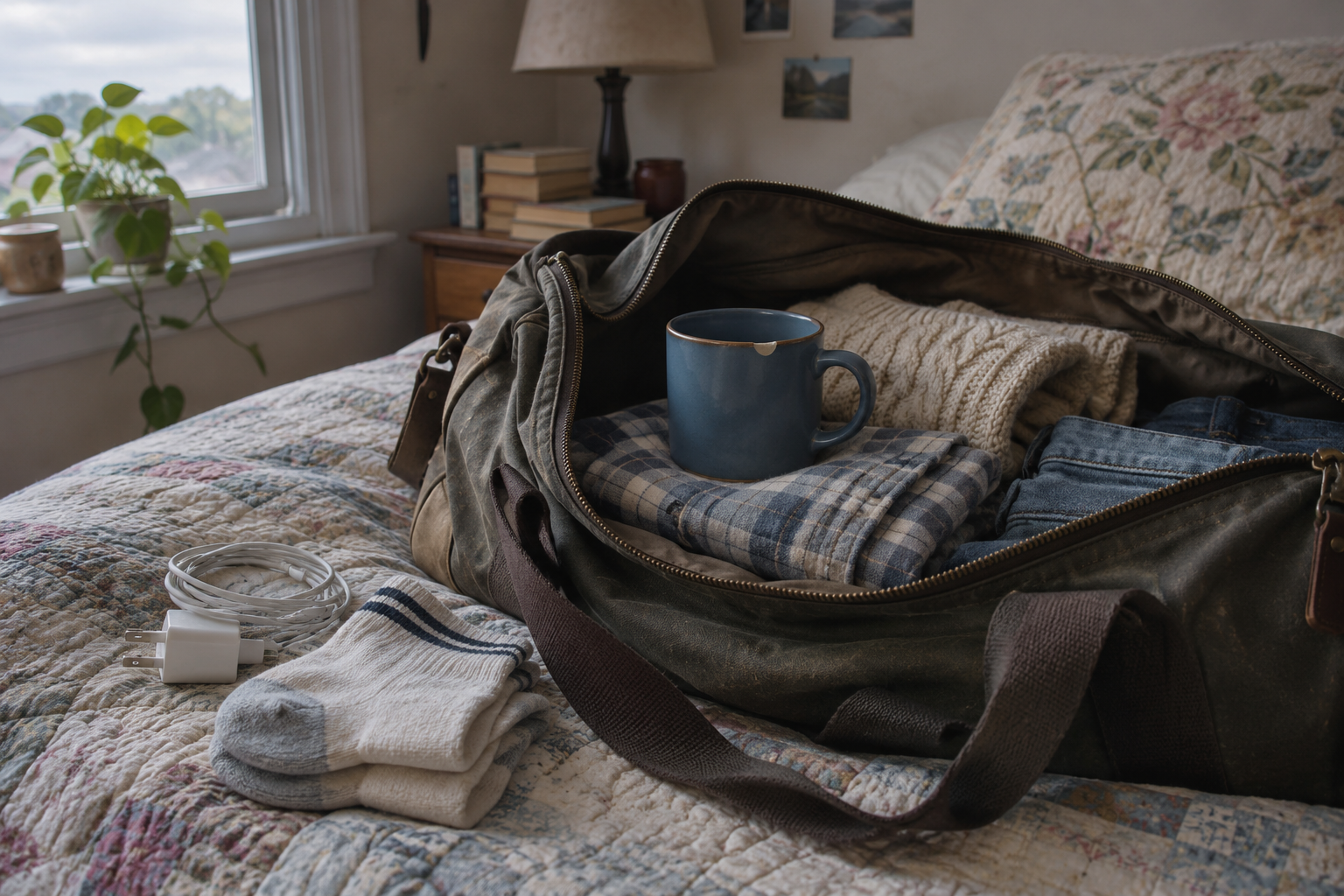
A woman is packing for a night at her sister’s house. She takes clean socks, a toothbrush and the charger beside her bed. At the front door, she remembers the blue mug her father used. She goes back to the kitchen, wraps it in a shirt and finds room for it in the bag.
She is still calling this an overnight visit. Taking the mug gives us a reason to wonder.
For a writer, that small return through the house offers more than a convenient way to explain her attachment to her father. She has to act on it. The mug has weight, occupies space and might break. Taking it requires a little care at a moment when she is trying to leave.
Stay with the practical difficulty for a few lines. Perhaps she has already put her shoes on and has to cross a wet kitchen floor. Perhaps the mug will not fit until she takes something else out. Either choice gives the object a consequence. If she removes tomorrow’s clean blouse to make room, we learn what she is willing to go without. There is no need to have her announce that the mug matters more.
Her sister can complicate the choice when she arrives. Seeing the bag, she might offer to carry it. The woman refuses too quickly, then tells her to take it from underneath. The sister has helped her move before and knows she never normally worries about luggage. Now an ordinary exchange can hold a question neither of them is ready to ask.
The meaning will depend on the person you are writing. One woman might take the mug because she expects to stay away. Another might know she cannot sleep in a strange place without something familiar. Both could insist they are coming home tomorrow and mean it. Decide what she understands about her departure before asking an object to reveal what she does not.
That is why I would be careful about treating a packed bag as a collection of ready-made symbols. A ring left on a dresser can suggest the end of a marriage. It can also belong to a machinist who removes it before work. The surrounding action has to earn the meaning. Otherwise, the reader may see a signal the writer has arranged instead of a choice this person would make.
Once the mug leaves the house, keep track of it. Your character may place it in her sister’s cupboard and then hesitate over which shelf to use. She may leave it wrapped in the bag. Either action develops the uncertainty introduced at the front door. Explaining the significance immediately would leave the later scene with less to discover.
You can try this during revision even if nobody in your story is planning to move. Give a character ten minutes to pack for one night away. Choose the destination first, so they have ordinary needs to consider. Write the packing as a scene, including whatever interrupts it.
Then let them reach the door and remember something. Follow them back for it. Notice what they have to open, move or leave behind to get it into the bag. Read the scene again with the explanations of their feelings removed. Put back only what the actions cannot make clear.
Later, if the overnight visit becomes a longer stay, return to the object. Let your character unwrap it and decide where it belongs.
Thank you, Paul. What a great tip and something all writers should keep in mind.

The church was supposed to be a refuge. The thing inside it knows your name.
Blurb
At St. Jude’s parish in Ripley, Ohio, a young volunteer’s possession turns a place of refuge into a scene of violence. Father Michael Donnelly hears his dead mother’s voice speaking through her. The call for help reaches Evan, a demonologist who recognizes signs of the terror he encountered as a child. As the entity uses memory and sacred spaces against them, both men must find a way to keep people alive.
Excerpt
Father Michael Donnelly hated closing St. Jude’s alone. During the day, a noise meant someone needed him. After hours he found himself listening before he answered, and he disliked knowing that about himself.
Smoke trailed from the snuffed candles. The stained glass had turned into black mirrors. A radiator ticked in the parish-house wall.
He locked the back room. The heavy brass key clacked in the wards. Through the door’s wired-glass pane, he checked the sanctuary lamp—the little red bulb near the altar—then reached for his wool winter coat.
The red lamp burned steady. He checked it once more before turning away.
Underneath his boots, something went thump.
Michael froze, his arm half-shoved into his coat sleeve. The metal teeth of his keys went cold against his palm.
Just the pipes, Mike, he told himself. Hundred-year-old building on an Ohio floodplain.
But it didn’t sound like pipes. Two deliberate strikes came nearer the stairwell. A pause. Then two more.
He wanted to leave. Emily Hart had stayed to put away supplies, but he’d thought she’d gone home. He crossed the room and pulled open the basement door.
The smell hit him first: meat left in heat and the stink of the Ohio River—stagnant mud and old pennies. He swallowed against it.
Buy links
https://www.paulmichaeldurivage.com/the-crossing
About the author

Paul Michael Durivage is a Michigan author and lifelong machinist with more than twenty-five years in precision manufacturing, including CNC work and supervision. His writing spans fiction, nonfiction, scripts and spoken word. His published books include the supernatural-horror novel The Crossing and the comic apocalypse novel Is the Apocalypse a Valid Use of Sick Days? He is interested in ordinary people facing extraordinary pressure, the choices they make and what those choices cost.
https://www.paulmichaeldurivage.com
https://www.paulmichaeldurivage.com/books


