
Please help me welcome today’s guest, M.G. de Grey…
Research for your novel or memoir
Someone said the past is another country. That just means your own memory will be unreliable, particularly if you are going back to childhood, and if you’re going back further, you will have to have to rely on other methods.
Where can you get your material?
- Your own experiences. We tend to remember emotions vividly. Transfer these to your characters.
- Books, diaries, letters, recorded verbal accounts, old school reports, etc.to provide information about attitudes, culture and living conditions
- The internet, particularly for facts, eg. What was the climate like at that time? What events happened? What jobs existed?
- Museums and art galleries
- People with specific expertise – policeman, midwife, etc. Don’t waste their time. Always go armed with a list of questions and try to get them to talk in a relaxed manner
- Photographs, especially to get a sense of place. Keep them on your computer desktop to refer to.
- In person
Colombia , in which my thriller Disappeared is set, is a country of huge contrasts: weather, terrain, society, rich and poor, exploiters and exploited, unbelievable beauty.
When I went to work in Colombia, I saw the street kids of Bogotá, hanging around the food stalls, hanging on the backs of lorries, a preferred method of travelling through the city, often falling to their death. They stole to eat, took drugs, dealt drugs. They were killed by citizens annoyed at their presence around the shops and businesses and were trafficked by gangs to be sold for sex or slave labour. These were not only teenagers, but also tiny creatures two or three years old. It was heartbreaking.
But for me, visits to the capital were infrequent, and most of my time was spent on the coast 400 miles to the north. I wouldn’t have known how to start doing something about the situation. What I did do, was keep notes of what I saw.
The research process
This is different for everyone, but you go into research with no concrete agenda and may emerge with a clear idea of how your story unfolds. Research can provide the glue for the various scenes and events or show a new way forward.
There are three prongs to your research:
1)General research, perhaps based on a keyword search e.g. WW2
2)Focussed research, e.g. The boats that came to rescue the soldiers at Dunkirk, and specifically the role of women in that event
- Read any books available
- Read news articles
- See films set in the era
- Explore archives
3)Double check the details to develop authentic scenes. Factual Accuracy is essential and will give your reader confidence in the story you tell.
- Use Google Maps to ‘walk’ or ‘drive’ down streets (if dealing with something close to the present) or historical maps and photos to capture what things looked like in the past
- Clothes
- Technology
- Language, music, books, etc
- Real events
- Set Google Alerts to receive newly arrived material on the internet
- Save a record of your sources as you go.
A good idea is to ask ‘Would they really do that? Would they have been able to do that?’ If you can’t answer, then the answer is to do more research.
Research can be great fun – or a pitfall which can clog up your narrative. Avoid doing this.
It’s hard to accept but two days of research can result in no more than a single line of text or it may simply influence the atmosphere of what you are writing.
In a novel, try to keep the facts of your research out of the first couple of chapters, and sometimes out of the book altogether.
Instead, gradually show the research as the information becomes necessary.
Example: Imagine you are writing about a young woman who worked as a domestic servant in the early 1900s. You’ve had to do a lot of research into the life of a domestic servant at the time. Here’s how you might possibly include that research and create an authentic background to your story.
Steam rose in the air of the basement and water sloshed into the rinse tub. Ellen pushed the shirt between the rollers and began to turn the wheel of the mangle. Her fingers were reddened and swollen, and she snatched back her hand when the bunched fabric made machine jump.
‘Get on with it, then!’
Mrs Drew, that old witch, didn’t allow any slacking, but one day, she’d escape from all this. She was only just sixteen, but she’d be gone from Boddington Hall by her next birthday. And it wouldn’t be to marry a dullard like Tom Cope.
What do we learn here?
- Aspects of life at the time
- A few things about Ellen’s background, character and situation
- An indication of where the story is moving
I suggested research could also offer a new way forward; how might the story have changed if she, or one of the other maids, had actually caught her hand in the rollers?
Mary Georgina de Grey, August 2026
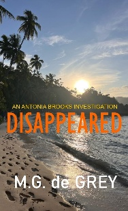
You can find Disappeared on Amazon and Good Reads.
Paperback UK https://amzn.eu/d/0aecH5X4
Paperback US https://a.co/d/0i8YMUg7
Kindle https://amzn.eu/d/03foIEZC
Kindle US https://a.co/d/00d9Tz7H
If you would like to donate or get involved, here is the link to the genuine charity (unlike the one in the story):
| Please support Friends of Alalay (Santa Cruz) a charity that finds, feeds, houses, educates and loves street kids in Santa Cruz, Bolivia Every penny raised goes directly to help the kids – there are no admin costs. Support our work here. Registered number 1123425 website www.alalay.co.uk |
It does excellent work. My most recent involvement was attending a concert in Bristol earlier this year. Two brilliant and well-known musicians gave their work free of charge to raise money for the charity.
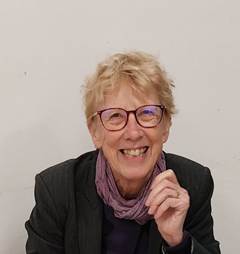
Website: https://marygeorginadegreyauthor.com/
Face Book: https://www.facebook.com/home.php
Instagram: https://www.instagram.com/marygeorginadegreyauthor/
X: MG de Grey Author
Mary Georgina de Grey


